

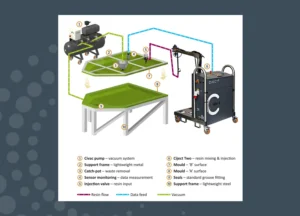
Vacuum Resin Transfer Moulding (VRTM) is a highly efficient Liquid Composite Moulding (LCM) process that bridges the gap between traditional vacuum infusion and high-pressure Resin Transfer Moulding (RTM). For manufacturers seeking improved fibre wetout, repeatable quality, reduced void content and scalable production – without the cost and complexity of high-pressure systems – VRTM offers a powerful alternative to high pressure Resin Transfer Moulding (RTM). In this guide, we explore:
- What VRTM is and how it works
- How VRTM differs from conventional RTM
- The key advantages of VRTM
- Industries where VRTM excels
- Why manufacturers increasingly adopt VRTM for high performance composite parts.
What Is Vacuum Resin Transfer Moulding (VRTM)?
VRTM is a closed mould composite manufacturing process where resin is drawn into a dry fibre preform using vacuum pressure – often assisted by low pressure controlled resin injection equipment.
Unlike open vacuum infusion, VRTM typically uses a matched, semirigid mould tool (upper and lower mould surfaces), delivering:
- Improved dimensional accuracy
- Better surface finish on both sides of the part
- Controlled resin flow paths
- Higher fibre volume fractions
The vacuum environment removes air and volatiles while ensuring consistent resin impregnation across complex geometries.
VRTM vs RTM – What’s the Difference?
Although VRTM and RTM are both closed mould processes, their resin delivery mechanisms and cost profiles differ significantly.
FEATURE | VRTM | TRADITIONAL RTM |
|---|---|---|
Resin pressure | Vacuum + low pressure | High pressure (often 5-10 bar) |
Tolling cost | Lower | Higher (rigid matched metal tools) |
Equipment Complexity | Moderate | High |
Void content | Very low | Low |
Scalability | Excellent | Excellent |
Energy Consumption | Lower | Higher |
Key distinctions:
VRTM uses vacuum as the primary driving force, often with precise low pressure resin injection support. RTM relies on high pressure pumps to force resin into a closed mould.
This makes VRTM:
- More accessible for medium volume production
- Less capital intensive
- Easier to adapt for large or complex parts
- Ideal for manufacturers transitioning from infusion to closed mould processes
Core Advantages of VRTM
1. Superior Part Quality
- Excellent fibre wetout
- Minimal voids and dry spots
- Consistent resin distribution
- High surface finish both sides
This results in improved mechanical performance and cosmetic quality.
2. Lower Tooling & Equipment Costs Compared to RTM
Because VRTM does not require ultrahigh pressure injection or heavy steel tooling:
- Tool manufacture is faster and cheaper
- Composite or hybrid moulds can often be used
- System complexity is reduced
This significantly lowers entry barriers for manufacturers scaling production.
3. Excellent Process Control & Repeatability
Modern VRTM systems enable:
- Accurate resin metering
- Controlled flow rates
- Degassing for void free laminates Data monitoring and process optimisation
This delivers repeatable part quality ideal for a host of sectors.
4. Higher Fibre Volume Fractions
The closed mould environment allows:
- Better compaction
- Controlled resin content
- Stronger, lighter components
These qualities are critical for high performance and lightweight applications.
5. Scalability from Prototypes to Production
VRTM works efficiently for:
- R&D and prototyping
- Low to medium volume manufacturing
- Large structural components
This flexibility makes it attractive for evolving production programmes.
Industries Where VRTM Excels
Aerospace & Advanced Air Mobility
VRTM is widely used for:
- Structural panels
- Fairings and covers
- Interior composite components
Benefits include:
- Tight dimensional tolerances
- Lightweight strength
- Repeatable quality
- Certification friendly consistency
Automotive & Performance Vehicles
Ideal for:
- Body panels
- Structural reinforcements
- Lightweight chassis components
- Battery enclosures (EV sector)
Why automotive manufacturers favour VRTM:
- Cost effective closed mould production
- High surface finish
- Reduced postprocessing
- Scalable output
Wind Energy & Renewable Structures
VRTM supports:
- Structural composite elements
- Reinforcement components
- Medium sized moulded parts
It offers excellent resin control, low waste, and high consistency – essential for long life energy infrastructure.
Marine & Offshore
Used for:
- Hull sections
- Deck components
- Structural reinforcements
- Hatches and window frames
Advantages include superior surface finish, corrosion resistance, and structural reliability.
Defence & High Reliability Manufacturing
Where controlled processes and traceability are critical, VRTM delivers:
- Process consistency
- Structural integrity
- Reduced defect rates
- Digital monitoring
When Should You Choose VRTM Over RTM or Infusion?
Choose VRTM if you need:
- Lower investment than high pressure RTM
- Closed mould quality control
- Repeatable production
- Scalability
VRTM is often the ideal stepping stone between traditional infusion and full RTM production environments.
VRTM & Modern Composite Manufacturing Systems
Advanced VRTM solutions now integrate:
- Automated resin injection
- Vacuum control systems
- Resin degassing
- Realtime data analysis
- Modular system expansion
These features support consistent production, improved yield, and reduced material waste.
Final Thoughts: Why VRTM Continues to Grow in Popularity
Vacuum Resin Transfer Moulding combines the best of infusion and RTM – delivering controlled quality, reduced cost, scalability, and superior mechanical performance.
For manufacturers focused on lightweight structures, production efficiency and repeatable quality, VRTM remains one of the most versatile and commercially attractive composite manufacturing processes available today.
Frequently Asked Questions
Is VRTM better than RTM?
VRTM is not a replacement for all RTM applications but offers lower cost, scalability, and excellent quality for many composite parts – especially where ultrahigh pressure is unnecessary.
Can VRTM achieve aerospace quality standards?
Yes. With proper tooling, resin control and degassing, VRTM produces void free, high performance laminates suitable for aerospace and high reliability sectors.
Is VRTM suitable for large composite parts?
Absolutely. VRTM performs particularly well for large and complex components where high pressure RTM becomes costly or impractical.