

Selecting the Right Manufacturing Process
As composite manufacturing continues to evolve, manufacturers are under increasing pressure to improve productivity while maintaining quality, consistency and cost efficiency.
Liquid moulding technologies have become central to meeting these demands. Rather than relying on a single manufacturing method, manufacturers now have a family of resin injection processes available, each designed to support different applications, production volumes and performance requirements.
Choosing between Resin Transfer Moulding (RTM), Vacuum Resin Transfer Moulding (VRTM) and High Pressure Resin Transfer Moulding (HP-RTM) is rarely about identifying the “best” technology. It’s about selecting the process that best aligns with your component, production objectives and long-term manufacturing strategy.
Understanding Resin Transfer Moulding (RTM)
Resin Transfer Moulding (RTM) is a closed-mould manufacturing process in which dry fibre reinforcements are placed inside a matched mould before resin is injected under controlled pressure.
Because the mould remains closed throughout injection and curing, manufacturers can achieve excellent dimensional accuracy, consistent laminate thickness and high-quality surface finishes on both sides of the component.
These characteristics have made RTM one of the most widely adopted liquid moulding technologies across aerospace, defence, marine and industrial composite manufacturing.
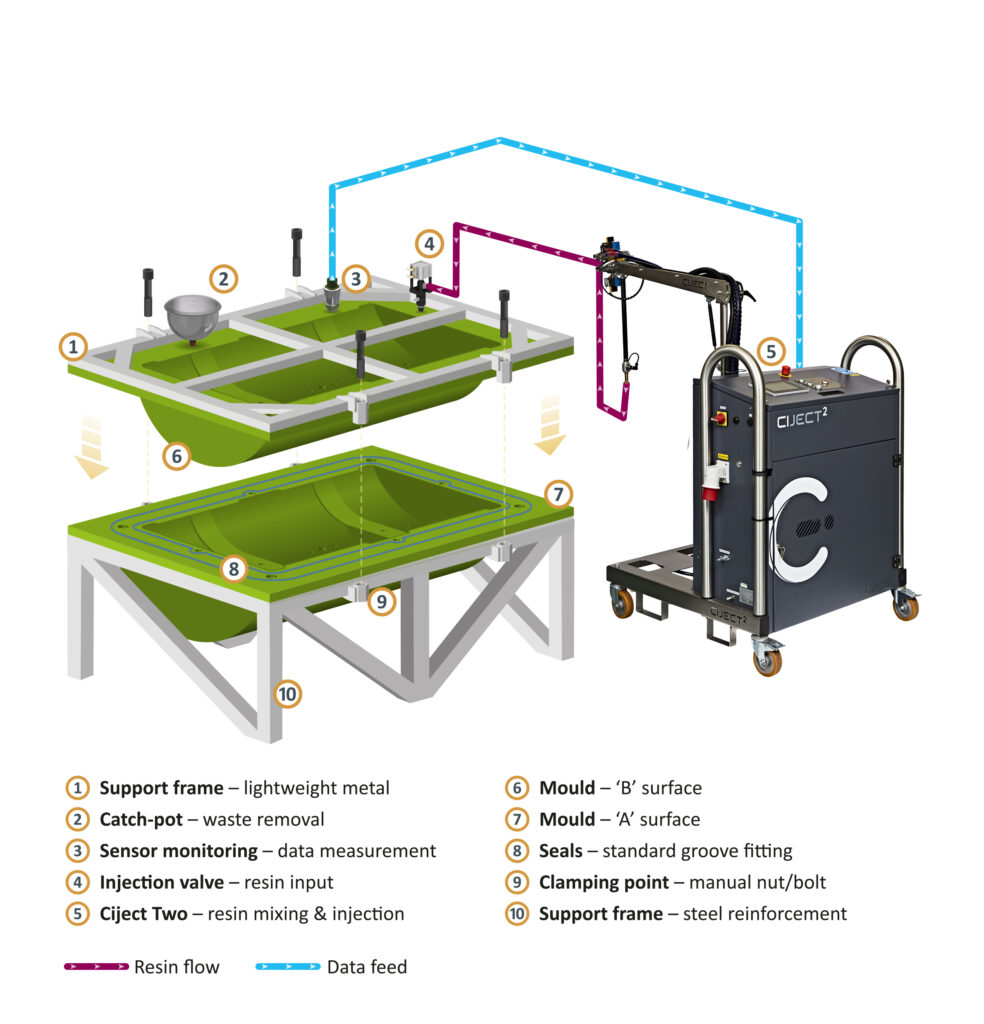
Figure 1. Typical RTM manufacturing cell incorporating resin processing, injection, process monitoring and mould tooling.
A typical RTM production cell combines several integrated technologies:
Component | Purpose |
|---|---|
CIJECT® 5 Resin Mixing & Infusion System |
Continuously meters, mixes and delivers resin directly to the mould. |
Injection Valve |
Controls resin entry into the mould cavity. |
Integrated Mould Pressure Sensors (IMPS) |
Provide real-time pressure feedback from within the mould, improving process visibility and control. |
Catch Pot |
Protects the vacuum system from resin contamination. |
Matched Mould Tooling |
Delivers accurate geometry and high-quality surface finishes. Clamping System Maintains mould integrity throughout injection and curing. |
Clamping Sytstem |
Maintains mould integrity throughout injection and curing. |
Working together, these elements create a controlled manufacturing environment capable of delivering consistent, repeatable production.
The RTM Family
Although often grouped under the same name, RTM encompasses several manufacturing processes, each suited to different production requirements.
Resin Transfer Moulding (RTM)
RTM is ideal where manufacturers require excellent dimensional accuracy, high-quality surface finishes and repeatable production.
Typical applications include:
- Aerospace structures
- Defence components
- Marine products
- Industrial composite parts
Key advantages include:
- Closed-mould manufacturing
- Excellent dimensional control
- High fibre volume fractions
- High-quality cosmetic finish
- Suitable for medium to high production volumes
Vacuum Resin Transfer Moulding (VRTM)
VRTM combines resin injection with vacuum assistance to improve resin flow through larger or more complex laminates.
It retains many of RTM’s advantages while making it easier to manufacture components where conventional RTM becomes less practical due to size or geometry.
Typical applications include:
- Large aerospace tooling
- Marine structures
- Infrastructure components
- Renewable energy applications
- Complex structural mouldings
VRTM offers:
- Improved resin distribution
- Consistent laminate quality
- Lower injection pressures
- Greater flexibility for larger components
High Pressure Resin Transfer Moulding (HP-RTM)
HP-RTM is designed for manufacturers requiring significantly shorter cycle times and higher production rates.
Using fast-reacting resin systems and higher injection pressures, HP-RTM enables rapid mould filling and fast curing, making it well suited to highly automated manufacturing environments.
Typical applications include:
- Automotive production
- High-rate aerospace programmes
- Lightweight structural components
- High-volume composite manufacturing
Key advantages include:
- Rapid cycle times
- High throughput
- Excellent repeatability
- Greater automation potential
MANUFACTURING REQUIREMENT | RTM | VRTM | HP-RTM |
|---|---|---|---|
High dimensional accuracy |
✔ |
✔ |
✔ |
Excellent surface finish |
✔ |
✔ |
✔ |
Large or complex components |
○ |
✔ |
○ |
Lower injection pressures |
○ |
✔ |
✕ |
High production rates |
✔ |
○ |
✔✔ |
Fast cycle times |
○ |
○ |
✔✔ |
Highly automated production |
✔ |
○ |
✔✔ |
✓✓ = Excellent fit, ✓ = Well suited, ○ = Suitable depending on the application, ✕ = Generally not recommended
Process Control Matters More Than the Process Alone
Selecting the right manufacturing process is only part of achieving successful production.
Whether using RTM, VRTM or HP-RTM, manufacturers must consistently control the variables that influence component quality.
These include:
- Resin temperature
- Resin viscosity
- Mix ratio accuracy
- Injection pressure
- Resin flow rate
- Mould pressure
- Cure conditions
Consistent control of these variables helps reduce variability, improve quality and create more predictable manufacturing outcomes.
Modern RTM Is Driven by Manufacturing Data
Today’s production environments increasingly rely on process data rather than operator judgement alone.
Modern RTM systems can integrate:
- Injection pressure monitoring
- Temperature monitoring
- Integrated Mould Pressure Sensors (IMPS)
- Process data logging
- Production traceability
- Recipe management
- Remote diagnostics
This gives manufacturers greater visibility into their manufacturing process, helping engineering teams validate production, identify trends and support continuous improvement. The result is greater confidence in every production cycle.
CIJECT® Across the RTM Family
Composite Integration’s CIJECT® resin processing systems have been developed to support the full range of liquid moulding technologies, including RTM, VRTM and HP-RTM.
With standard, customised, and modular systems available, CIJECT® combines resin conditioning, accurate metering, mixing, injection and process monitoring within a configurable manufacturing system tailored to individual production requirements.
Whether supporting research programmes, prototype manufacture or fully automated production cells, CIJECT® provides manufacturers with the process control and flexibility needed to support long-term manufacturing success.
More Than Equipment
Successful RTM implementation depends on more than selecting the right machine. It requires the right manufacturing process, tooling strategy, resin processing approach and production expertise.
From early-stage process development and tooling through to customised manufacturing systems, installation, commissioning, operator training and ongoing technical support, Composite Integration partners with manufacturers to transform manufacturing concepts into reliable, repeatable production.
Because successful composite manufacturing isn’t simply about choosing the right technology. It’s about implementing the right process, with the right partner.