

Outstanding composite components are defined by more than structural performance. The design decisions made during development also determine how easily, reliably and economically those components can be manufactured throughout the life of a programme.
As production rates increase across aerospace, wind energy, marine and other high-performance composite industries, manufacturers are recognising that long-term success depends not only on how a component performs in service, but on how effectively it can be manufactured consistently, efficiently and at scale.
Performance Is Only Part of the Design Challenge
Composite engineering has always been driven by performance. Engineers strive to reduce weight, increase strength, improve stiffness and satisfy increasingly demanding structural requirements, often pushing materials and manufacturing technologies to their limits. Achieving those objectives remains fundamental, but they are no longer the only measure of success.
As production rates increase across aerospace, wind energy, marine and other high-performance industries, manufacturers are placing greater emphasis on another question: How effectively can this component be manufactured throughout the life of the programme?
A design that performs exceptionally in service may still present unnecessary manufacturing challenges if production has not been considered from the outset. Components that are difficult to infuse, require continual operator intervention or rely on highly specialised manufacturing techniques can become increasingly difficult to manufacture as production volumes grow.
Structural performance may secure programme approval, but manufacturability often determines whether that programme succeeds in production.
Performance vs Manufacturability
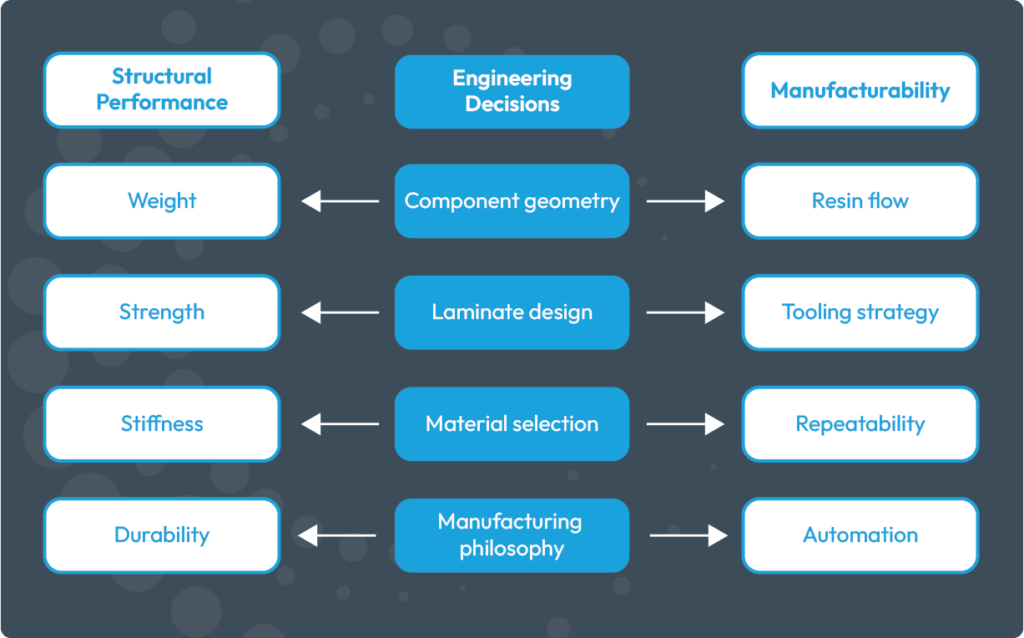
Successful programmes optimise both structural performance and manufacturability – not one at the expense of the other.
Manufacturability Is a Design Requirement
Composite components are traditionally designed around engineering requirements such as strength, weight, stiffness, durability and cost. Increasingly, manufacturability deserves to sit alongside them.
A component that satisfies every structural objective but proves difficult to manufacture consistently introduces unnecessary complexity throughout production. Poorly considered geometry, laminate architecture or tooling strategy can lead to longer cycle times, greater operator dependency and limited scalability once production begins.
Designing for manufacture is not about compromising engineering ambition. It is about ensuring engineering decisions also support practical, repeatable production. The strongest programmes achieve both, creating components that deliver exceptional performance while remaining efficient to manufacture.
Rather than asking “Can we manufacture this component?” manufacturers are increasingly asking: “Can we manufacture it repeatedly, efficiently and economically over the next ten years?”
Manufacturing Begins Long Before Production
Manufacturing challenges rarely begin on the factory floor. By the time production equipment is installed, many of the decisions that determine manufacturing performance have already been made.
Component geometry influences resin flow. Laminate architecture affects material handling and consolidation. Tooling strategy shapes dimensional stability, while gate and vent locations influence how consistently a mould fills. Collectively, these decisions determine how robust the manufacturing process will become once production begins.
The earlier manufacturing expertise is introduced into product development, the greater the opportunity to reduce production risk, simplify manufacturing and establish a more capable production process.
Early Decisions Have the Greatest Influence
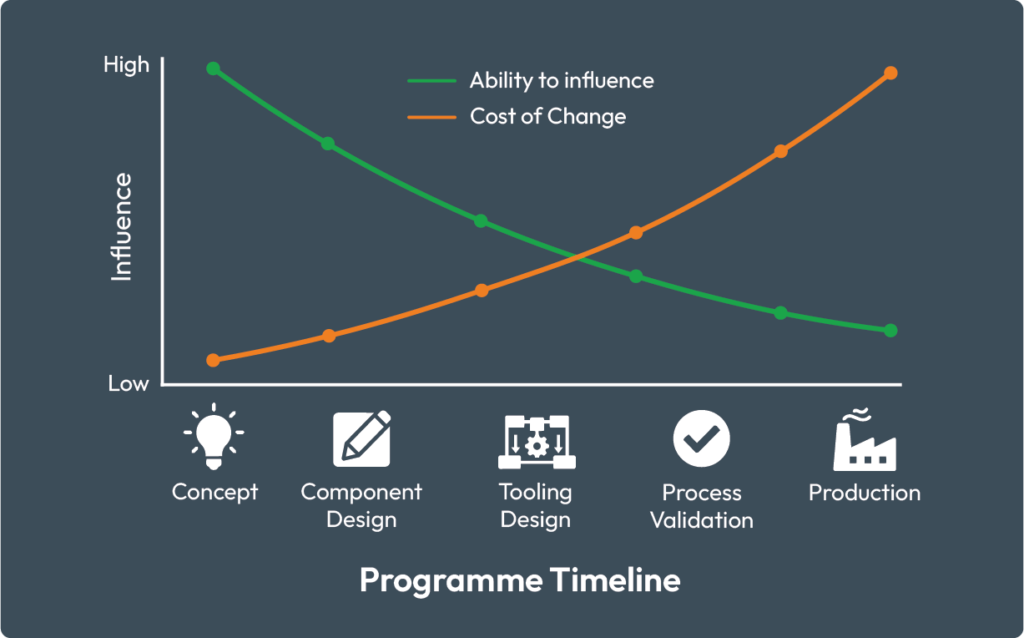
The earlier manufacturing thinking is introduced, the greater its long-term impact
Design Freedom Brings Manufacturing Responsibility
Composite materials provide engineers with exceptional design freedom, allowing highly optimised structures and complex geometries that would be difficult to achieve using conventional manufacturing methods.
That freedom also introduces greater manufacturing responsibility.
Every increase in design complexity creates additional considerations for tooling, resin flow, processing strategy and production consistency. The challenge is no longer simply determining what can be designed, but understanding what can be manufactured reliably throughout the life of a programme.
The organisations achieving the greatest success recognise that engineering performance and manufacturing performance should evolve together rather than independently.
“The question is no longer simply what can be designed, but what can be manufactured reliably throughout the life of a programme.”
Better Design Creates Better Manufacturing
When manufacturing considerations are introduced during development, the benefits extend far beyond the first production component.
Resin flow becomes more predictable. Material placement becomes easier to standardise. Tool access, demoulding and inspection can be considered before tooling is committed. Gate and vent strategies can be developed around the geometry rather than adapted later to compensate for it.
These decisions improve more than part quality. They make tooling easier to design, processes easier to validate, cycle times easier to predict and future automation easier to introduce.
Designing for manufacture is therefore about creating manufacturing capability rather than simply solving today’s engineering challenge.
Engineering Better Manufacturing Together
Designing for manufacture requires collaboration across disciplines. Component designers, tooling engineers and process specialists each contribute different expertise that influences the final production outcome.
The strongest programmes bring these perspectives together before the design becomes fixed, when changes are easier to make and have the greatest long-term impact.
At Composite Integration, we support manufacturers by bringing process development, tooling and manufacturing expertise into product development at the earliest opportunity. By considering manufacturability alongside structural performance, we help customers establish production processes that are practical, scalable and ready for long-term manufacture.

Designing Components for Long-Term Success
As composite manufacturing continues to industrialise, manufacturability will become one of the defining characteristics of successful programmes. The organisations that consider manufacturing alongside performance from the earliest stages of design will reduce production risk, improve scalability and establish a stronger foundation for long-term growth.
Designing for manufacture is not about limiting engineering ambition. It is about ensuring that high-performance components can also be produced reliably, efficiently and repeatedly throughout the life of a programme.
Because if you can’t repeat it, you can’t scale it.
The best composite parts aren’t just designed to perform, they’re designed to be manufactured.