

Across the composites industry, manufacturers are facing increasing pressure to produce larger structures, improve repeatability and reduce variability — all while accelerating production and maintaining quality.
Yet many manufacturing processes still rely on methods developed for low-volume production, prototyping or early-stage development.
The reality is that a process which performs well in R&D or small-scale manufacture does not always translate successfully into repeatable production.
Challenges Faced When Scaling Composite Production
As demand for industrialised composite manufacture grows, many manufacturers are beginning to encounter the same challenges:
- inconsistent infusion behaviour
- variable resin quality
- increased scrap rates
- operator dependency
- limited process visibility
- scaling difficulties across larger structures
These challenges are rarely caused by a single issue. More often, they are symptoms of processes that were never designed for scalable production in the first place.
Aerospace and Wind Are Facing the Same Scaling Challenge
While aerospace and wind energy operate at very different production scales, both sectors are increasingly facing the same challenge: scaling composite manufacturing without sacrificing control.
Wind energy has already demonstrated what large-scale composite production looks like, with major turbine manufacturers producing thousands of blades each year. However, increasing blade size and production demands continue to expose challenges around variability, process consistency and repeatability.
Aerospace, meanwhile, has mastered precision and certification control, but is now under increasing pressure to industrialise production at far higher rates than many existing processes were originally designed for.
As aircraft backlogs continue to grow and next-generation wind structures become increasingly complex, both industries are entering a new phase of manufacturing pressure.
The challenge is no longer simply producing composite structures.
The challenge is producing them repeatedly, reliably and at scale.

Traditional Processes Are Reaching Their Limits
Composite manufacturing is evolving rapidly.
Sectors including aerospace, wind energy, marine and defence are all demanding:
- larger and more complex components
- improved consistency
- higher production throughput
- reduced waste
- better traceability
- greater process control
At the same time, labour shortages and increasing quality expectations are exposing the limitations of heavily manual manufacturing approaches.
For many manufacturers, scaling production is no longer simply about increasing output. It is about creating stable, repeatable and controllable processes capable of delivering consistent results over time.
That shift requires a different way of thinking about liquid resin processing.
Scaling Reveals Hidden Process Instability
A process may appear successful at smaller scale while hidden variability remains manageable.
However, as production volumes increase or part sizes become larger, small inconsistencies often become amplified.
This can include:
- unstable resin delivery
- air entrainment
- inconsistent degassing
- uneven flow behaviour
- fluctuating pressure conditions
- temperature variation
- inconsistent cure quality
When these variables are not properly controlled, manufacturers can experience:
- increased defects
- reduced repeatability
- higher material waste
- greater reliance on operator intervention
- unpredictable production outcomes
In many cases, the process itself becomes the limiting factor to growth.
Repeatability Is Becoming a Competitive Advantage
As the industry matures, repeatability is increasingly separating scalable manufacturers from those struggling to move beyond low-rate production.
Manufacturers able to achieve consistent process control gain advantages in:
- quality assurance
- throughput
- labour efficiency
- material utilisation
- certification confidence
- production scalability
This is particularly important for sectors such as aerospace and wind energy, where process stability directly impacts both performance and commercial viability.
The ability to monitor, control and repeat manufacturing processes consistently is becoming just as important as the final component itself.
Industrialisation Requires Process Control
The future of composite manufacturing will not be built on manual correction and reactive problem-solving.
It will be built on:
- advanced liquid resin processing
- process visibility
- controlled resin delivery
- repeatable infusion strategies
- integrated monitoring
- scalable manufacturing infrastructure
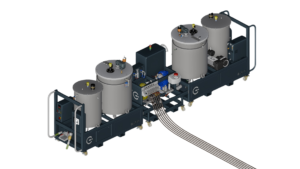
This is where technologies such as CIJECT resin infusion and injection systems, Direct Infusion and advanced degassing solutions become increasingly important.
Controlled resin processing infrastructure helps manufacturers improve repeatability, reduce variability and gain greater production confidence as manufacturing scales.
Rather than relying on operator intervention to maintain consistency, manufacturers are moving toward more stable and repeatable manufacturing environments designed for production-scale performance.
The Future of Large-Scale Composite Production
As composite structures continue to increase in scale and complexity, the industry must move beyond simply making parts and begin focusing on how those parts can be manufactured consistently at production scale.
The question is no longer:
“Can this component be manufactured?”
The question is:
“Can this process be repeated reliably, efficiently and at scale?”
Because in modern composite manufacturing, scalability is no longer optional – it is becoming essential.