

As composite manufacturers move from prototype production into larger-scale manufacture, many quickly realise that scaling production is not simply a case of increasing output or installing larger equipment.
Production scale changes everything.
Processes that appear stable during development can become increasingly inconsistent as:
- part sizes increase
- production volumes rise
- labour demands grow
- quality expectations tighten
- manufacturing schedules accelerate
The challenges of large scale composite production is not simply producing more composite components.
The challenge is maintaining repeatability, consistency and process control while production scales.
Scaling Is Not a Capacity Problem – It Is a Control Problem
There is often a tendency to treat scaling as a capacity challenge.
Add more equipment.
Add more operators.
Add more production lines.
However, scaling unstable processes only increases inefficiency.

Large-scale infusion and RTM processes require far greater process stability than many traditional manufacturing methods can consistently deliver.
This is why manufacturers are placing increasing focus on:
- controlled resin delivery
- degassing
- process monitoring
- closed-loop pressure control
- repeatable infusion strategies
Repeatability Matters More Than Speed
As composite manufacturing evolves, repeatability is becoming one of the industry’s most important competitive advantages.
A process that delivers stable and repeatable results creates benefits across:
- quality assurance
- material efficiency
- production planning
- labour efficiency
- certification confidence
- long-term scalability
This is particularly critical within aerospace and wind energy manufacturing, where production stability directly impacts programme risk and commercial viability.
Technologies Supporting Production Scale
Controlled resin processing plays a major role in improving manufacturing consistency at scale.
How to Scale Composite Manufacturing
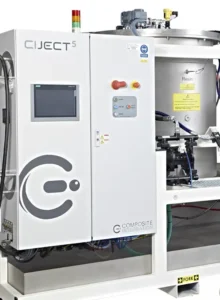
Technologies such as CIJECT metering and mixing systems help manufacturers achieve more stable resin processing conditions through greater control over resin delivery during production.
Composite Integration’s Direct Infusion technology was developed specifically to support large-scale infusion manufacturing through closed-loop pressure control, helping improve repeatability during large infusions.
At the same time, advanced degassing and process monitoring technologies are helping manufacturers move from reactive quality control toward more controlled and repeatable production environments.
Production Confidence Defines Successful Scale-Up
The future of composite manufacturing will not be built on unstable processes and manual correction.
It will be built on:
- process visibility
- repeatable manufacturing conditions
- controlled resin delivery
- scalable production infrastructure
- production confidence
Because the challenge is not making one good part.
The challenge is making thousands consistently.