

Many composite manufacturers believe scale-up problems begin when production starts increasing. In reality, most of them begin years earlier during process development.
When production challenges emerge, the focus often falls on the factory floor. Questions are asked about equipment, labour, training, bottlenecks and production capacity. However, many scale-up challenges do not originate during production. They originate years earlier during process development.
By the time a manufacturing team encounters repeatability issues, scrap, variability or throughput limitations, the foundations of those challenges have often already been established. The uncomfortable reality is that many production problems are not created when manufacturing scales. They simply become visible.
Development and Production Optimise for Different Outcomes
Process development and production environments have fundamentally different objectives. Development programmes are often focused on proving technical feasibility.
Success is measured by questions such as:
- Can the component be manufactured?
- Does it achieve performance targets?
- Can design requirements be met?
- Can the process be validated?
Production environments measure something very different.
Questions become:
- Can the process be repeated consistently?
- Can it support production rates?
- Can variation be controlled?
- Can outcomes be predicted?
- Can quality be maintained at scale?
The challenge is that a process capable of producing a successful demonstrator is not automatically capable of supporting industrialised manufacture. This is not because development teams make poor decisions. In many cases they are making exactly the right decisions for the objectives in front of them.
The difference is that development programmes are focused on proving capability, while production programmes are focused on delivering consistency, throughput, repeatability and efficiency. The manufacturing decisions that optimise one objective do not always optimise the other.

Manufacturing Success and Production Success Are Not the Same Thing
One of the most common assumptions in composites manufacturing is that a successful development programme naturally leads to a successful production programme.
In reality, the skills required to prove a process and the skills required to industrialise a process are often very different.
- Development rewards flexibility → Production rewards repeatability
- Development rewards innovation → Production rewards consistency
- Development tolerates variation → Production exposes it
This is one reason why organisations increasingly seek industrialisation expertise earlier in the development cycle.
The objective is no longer simply proving that a part can be manufactured. The objective is proving that it can be manufactured repeatedly, efficiently and predictably when production demands increase. Industrialisation is not about making more parts. It is about removing uncertainty from every part you make.
Across the composites industry, manufacturers are under increasing pressure to deliver higher production rates while maintaining quality, consistency and cost control.
When production challenges emerge, the focus often falls on the factory floor. Questions are asked about equipment, labour, training, bottlenecks and production capacity. However, many scale-up challenges do not originate during production. They originate years earlier during process development.
By the time a manufacturing team encounters repeatability issues, scrap, variability or throughput limitations, the foundations for those challenges have often already been laid. The uncomfortable reality is that many production problems are not created when manufacturing scales. They simply become visible.
Development Decisions Can Shape Production Outcomes Years Later
The influence of process development decisions is often underestimated.
Manufacturers naturally focus on proving technical feasibility during development. However, the decisions made at this stage frequently determine how easily a process can transition into production later.
A good example can be found in Composite Integration’s ongoing collaboration with Safran Nacelles.
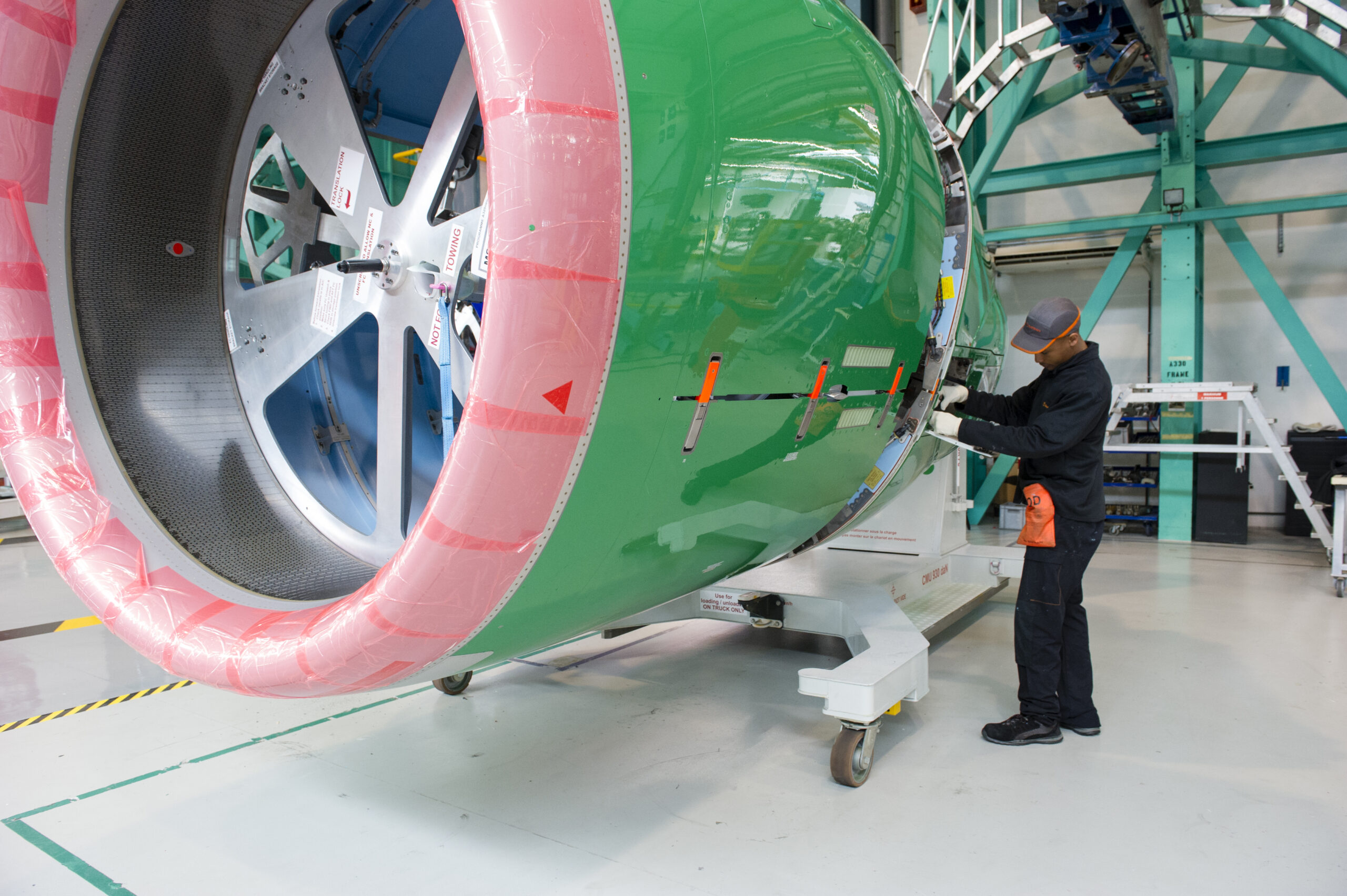
As part of the Propound programme, Safran sought to evaluate whether resin infusion could provide a viable alternative to traditional aerospace pre-preg manufacturing methods while maintaining the stringent quality and structural requirements expected within the aerospace sector.
The initial objective was to demonstrate technical feasibility.
Working alongside Safran Nacelles and the University of Nottingham, Composite Integration helped develop a complete aerospace resin infusion methodology, including bespoke infusion equipment with integrated process monitoring and data collection capabilities.
The programme successfully demonstrated that aerospace-quality components could be manufactured using resin infusion techniques, achieving:
- Equivalent component specifications to the existing pre-preg process
- Reduced component weight
A 25% reduction in production costs - High fibre fractions
- No detectable porosity
However, perhaps the most valuable outcome was not simply proving that the process worked.
It was establishing a foundation that could now be refined and industrialised for future production applications.
The programme has since progressed into a second phase focused on process refinement, production readiness and wider implementation.
What makes this programme particularly significant is that it did not stop once feasibility had been demonstrated. It recognised that proving a process works and preparing it for production are two very different stages of industrialisation.
That distinction is becoming increasingly important across the composites industry. The decisions made during development do not simply influence whether a part can be manufactured. They influence how effectively that process can evolve into a repeatable production environment years later.
Manufacturing Problems Often Appear Long After They Are Created
One of the biggest misconceptions surrounding industrialisation is that production problems are created during production. In reality, many are simply becoming visible.
A process may appear stable when producing a limited number of components. As production volumes increase, however, small sources of variability become increasingly apparent. What was previously manageable through operator intervention can become a significant production challenge. A variation that appears insignificant during development can become highly consequential once production rates increase.
Minor differences in resin preparation, process timing, temperature control or material handling may have little impact when producing a handful of demonstrators. Repeated hundreds or thousands of times, those same variations can affect quality, throughput, labour efficiency and manufacturing confidence.
This is one reason why scale-up often feels difficult. The manufacturing process is not necessarily failing. It is simply being asked to perform under conditions it was never originally designed for.

Industrialisation Is No Longer a Production Activity
Traditionally, industrialisation was often viewed as something that happened once a product had been proven.
Increasingly, manufacturers are recognising that industrialisation needs to begin much earlier. Decisions made during concept development, tooling design, resin processing strategy and process selection can influence manufacturing performance years later.
The manufacturers achieving the greatest success at scale are increasingly asking different questions. Rather than asking: “Can this component be manufactured?” They are asking: “Can this process support future production requirements?”
That shift influences:
- Process architecture
- Resin processing strategy
- Tooling philosophy
- Monitoring requirements
- Automation opportunities
- Manufacturing infrastructure
Most importantly, it reduces the risk of discovering industrialisation challenges after production expectations have already increased.
Why Process Expertise Matters
Technology plays an important role in industrialisation. However, equipment alone rarely solves manufacturing challenges.
Successful scale-up typically requires a combination of process understanding, manufacturing expertise, appropriate technology selection and production planning. This is why many organisations increasingly seek partners capable of supporting process development as well as production implementation.
The objective is not simply to create a process that works. It is to create a process that continues to work as manufacturing demands evolve.
The manufacturers scaling most successfully are rarely those that focus solely on equipment selection. They are usually those that understand how materials, tooling, resin processing and manufacturing objectives interact within a complete production system.
Looking Ahead
The composites industry continues to push the boundaries of component size, performance and production volume.
As industrialisation accelerates, manufacturers that design production requirements into the development process from the outset are likely to gain significant competitive advantages.. The most successful organisations are increasingly designing processes with production in mind from the very beginning. Not because they know exactly what future production requirements will be. But because they understand that changing a manufacturing strategy late in a programme is often far more difficult than building industrialisation into the process from the start.
In an industry increasingly focused on production rate, repeatability and efficiency, that mindset may become one of the most important competitive advantages of all. Because many manufacturing challenges do not begin on the factory floor. They begin during process development. The manufacturers that scale most successfully are those that design industrialisation into the process long before production begins.